Applications
Five load environments, five different builds — and the detail that matters most in each.
Parking Structure Decks & Ramps
Parking decks combine every difficult load on this site into one structure. Vehicles turn constantly at low speed, which is the worst case for torsional shear. Ramps add braking force on a slope. And from November through March, every vehicle delivers a fresh load of chloride brine directly onto the deck and lets it drip.
Chloride is the long-term threat, not the tires. It reaches the steel through any breach — a crack at a joint, an unsealed drain flange, a delamination at a column base — and once it is there, corrosion drives section loss where nobody can see it.
Ramps and turning bays get the highest build and the most aggressive aggregate, because they combine slope, wetness, and steering shear at the same location.
Spec: OR-80SLM waterproofing plane at 40–60 mil, FJ1 wearing course at 60–80 mil over it for a 100–120 mil total system on ramps and turning bays. 80–100 mil on flat parking bays. Aggregate broadcast throughout; 7001 Primer at all drains, joints, curbs, and column bases.
Marine, Pier & Vessel Decking
Marine decks stack permanent chloride exposure on top of heavy, concentrated loads — forklifts moving freight, equipment skids, and in the case of barge and vessel decks, cargo that arrives all at once.
Prep is the whole job here. Soluble chloride below 7 µg/cm² is a required verification, not a best practice. Salt contamination is invisible, survives a wash that looks thorough, and will osmotically blister the best membrane made. Test, wash, retest — and only then blast to SP6 and coat.
Skid resistance carries different weight on a marine deck than anywhere else. The surface is wet essentially all the time, it is frequently moving, and a fall is a serious event. Aggregate grade is specified upward accordingly.
Spec: Chloride verification below 7 µg/cm², SSPC-SP6 blast to 2–4 mil profile, OR-80SLM at 60 mil, FJ1 at 40–60 mil over traffic areas with coarse aggregate broadcast. Total 100–120 mil on working decks.
Loading Platforms & Dock Decks
The loading platform is a concentrated-load problem. Forklift wheels are hard, small, and heavily loaded, and they cross the same few feet of deck hundreds of times a shift. Pallet corners and dropped freight add impact at random points.
The dock edge is the detail that decides the job. It takes trailer wheel loads at an angle, it takes leveler plate impact, and it is the point where the membrane terminates. A poorly detailed edge is an open invitation for water and a starting point for peel.
Wash-down and de-icer exposure at dock level is heavier than anywhere else in most facilities, so the waterproofing continuity through drains and the pit perimeter needs the same attention as the field.
Spec: FJ1 at 100–120 mil across the platform deck with medium aggregate broadcast, OR7K at 40–60 mil on supporting framing and the deck underside. 7001 Primer at the edge angle, leveler pit perimeter, and all drains.
Industrial Equipment & Crane Runway Decks
Some decks never see a vehicle and are still the hardest service on this list. Equipment platforms carry static point loads from anchored machinery, plus vibration transmitted continuously into the deck plate. Crane runway and rail decks take concentrated rolling load along a fixed line, thousands of cycles.
Cyclic loading is a fatigue environment, and fatigue finds rigid films. This is the clearest case for specifying elongation over hardness: the membrane has to accept several hundred thousand small movements without work-hardening into a crack.
Chemical exposure usually comes along for the ride — hydraulic fluid, cutting oil, and coolant end up on any equipment deck eventually, and they sit there until the next cleaning cycle.
Spec: FJ1 at 100–120 mil under equipment footprints, rail lines, and access routes; OR7K at 40–60 mil across the balance of the deck and framing. Aggregate broadcast on all walking routes.
Wash Bays & Maintenance Decks
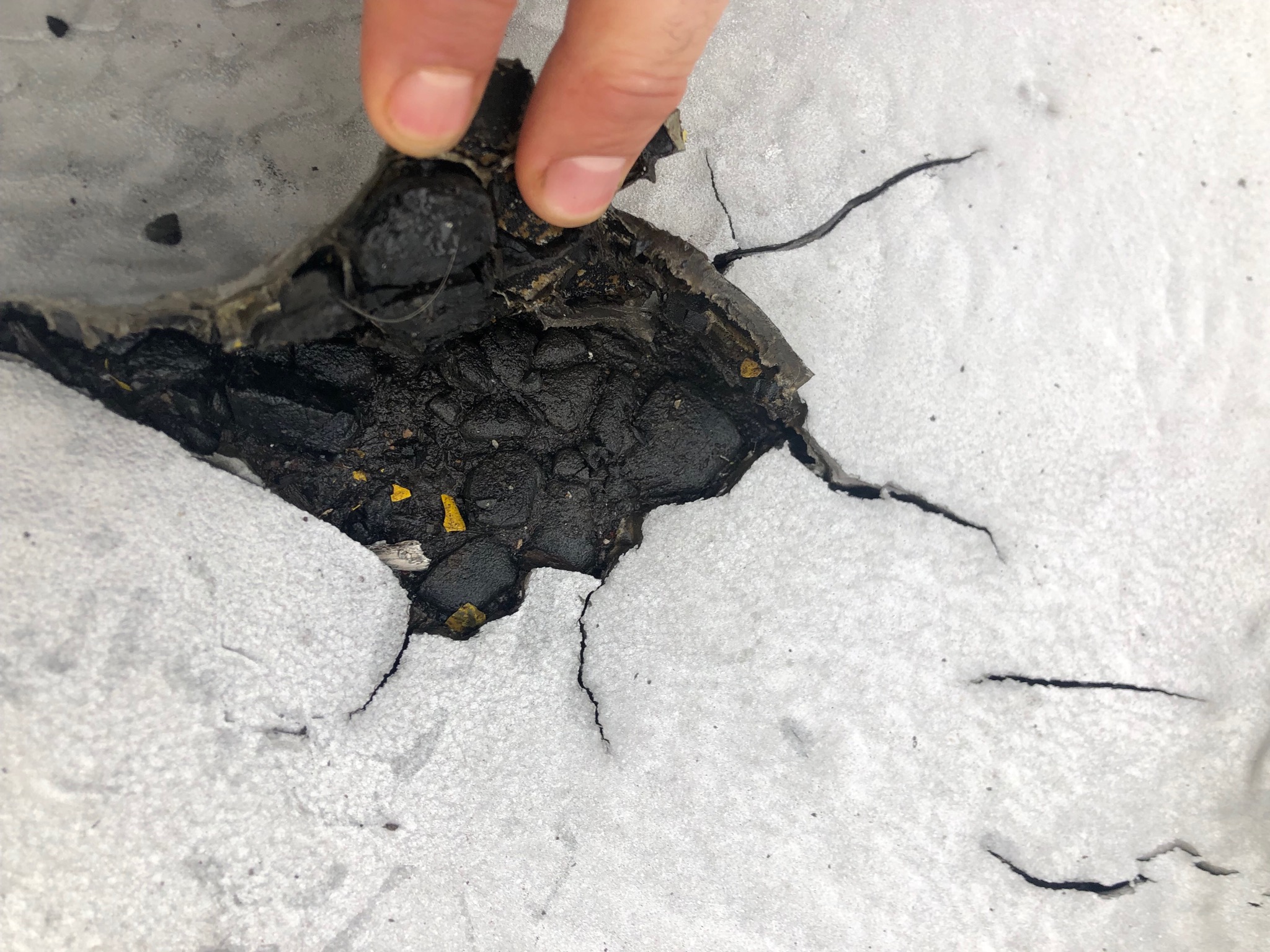
A wash bay deck is permanently wet, permanently chemically loaded, and driven on. Detergents, degreasers, road grime, and de-icer residue all end up in the same water, and that water goes wherever the slope sends it.
Two things dominate the spec. Traction, because the deck is never dry and vehicles are being maneuvered on it — this is the highest aggregate grade we spec. And drainage continuity, because every drop of water on that deck is heading for a drain and the membrane has to still be intact when it gets there.
Coving at every wall and curb is mandatory rather than optional. Water on a wash deck is under pressure and directed, not passive.
Spec: OR-80SLM at 40–60 mil as the waterproofing plane, FJ1 at 60 mil over it with coarse aggregate broadcast. Integral cove at all walls and curbs, membrane carried into drain bodies, 7001 Primer at every transition.
Additional Traffic-Bearing Applications
- Helipads and rooftop vehicle decks — waterproofing over occupied space with a marked, skid-resistant surface
- Bridge decks, gangways and ramps — movement-tolerant membrane over a structure that never stops flexing
- Elevated drive lanes and access roads — continuous membrane across steel deck and concrete transitions
- Rail loading and transfer decks — concentrated rolling load on fixed lines
- Grating infill and open-mesh replacement panels — sealed and given a permanent traction surface
- Secondary containment on trafficked decks — coved, seamless, chemically resistant, and inspectable
- Stair towers, landings and egress routes — traction that is part of the membrane instead of applied tape
- Localized deck repair and re-coat — chemically bonded into the existing membrane, introducing no new seam
Describe the Load and the Details
What crosses the deck, how often, how much of it turns in place, and what the joints, drains and terminations look like. We will come back with a load-class spec and an aggregate grade.
Talk to an EngineerGet a Traffic-Bearing Spec
Tell us about your project and we will follow up with product details, technical data sheets, and pricing.